Cricket is one of the most data-rich sports in the world. From ball-by-ball commentary during an IPL thriller to historical player stats spanning decades, the volume of information is massive. For developers, accessing this data reliably is the foundation for building live score websites, fantasy cricket apps, mobile match centers, analytics dashboards, and AI-powered cricket tools.
A Cricket API solves this challenge by delivering structured, real-time, and historical cricket data through simple REST endpoints (and often WebSockets). Instead of scraping websites or maintaining fragile data pipelines, you get clean JSON responses with live scores, scorecards, player statistics, fixtures, fantasy points, and more.
This guide covers everything developers need to know about Cricket APIs — what they offer, how they work, popular providers, and how to integrate them into your next project.
What is a Cricket API?
A Cricket API is a set of programmatic endpoints that provide cricket-related data. Most modern Cricket APIs are RESTful and return data in JSON format. Many also support real-time delivery methods such as WebSockets, Webhooks, or Firebase for low-latency live updates.
Typical data categories include:
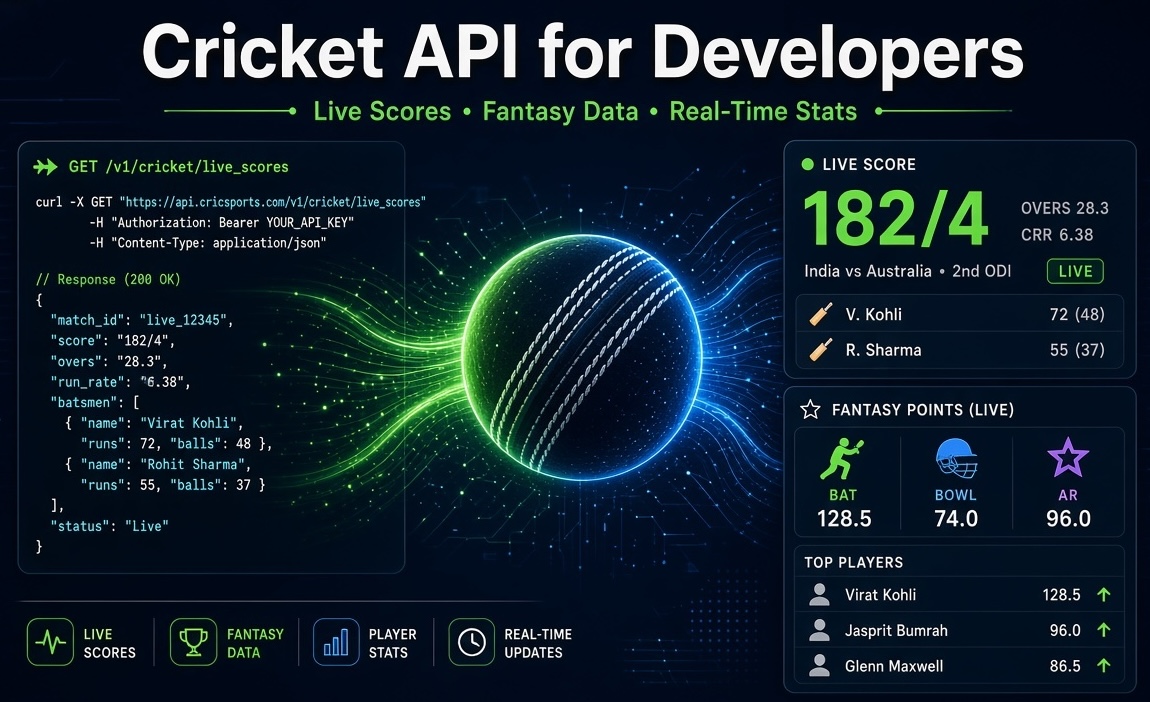
- Live Scores — Current match status, runs, wickets, overs, required run rate, and last few balls
- Ball-by-Ball Commentary — Detailed event-level updates as the match progresses
- Full Scorecards — Batting and bowling figures, partnerships, fall of wickets, extras
- Fixtures & Schedules — Upcoming, live, and completed matches across formats (Test, ODI, T20)
- Player & Team Stats — Career records, recent form, series statistics, rankings
- Fantasy Data — Pre-calculated player credits, fantasy points, squad information, and role-based insights
- Tournament Data — Points tables, standings, squads, and series-level statistics
- Odds & Insights (on some providers) — Match odds, win probability, and advanced analytics
Why Developers Use Cricket APIs
Building cricket products without a reliable data source is time-consuming and error-prone. A good Cricket API offers:
- Real-time accuracy — Updates as fast as television broadcasts during high-traffic events like the IPL or World Cup
- Structured data — Consistent schemas that are easy to parse and display
- Coverage — International matches, major T20 leagues (IPL, BBL, PSL, CPL, SA20, etc.), and often domestic competitions
- Scalability — Handles peak loads when millions of fans are checking scores simultaneously
- Developer experience — Clear documentation, authentication via API keys, SDKs, and sample code
Common use cases include:
- Live score websites and mobile apps
- Fantasy cricket platforms (daily and season-long)
- Match center pages with detailed scorecards and commentary
- Sports analytics dashboards and leaderboards
- Chatbots and AI assistants that answer live cricket queries
- News portals that auto-update scores and results
- Betting and odds platforms (where supported)
Key Features of a Modern Cricket API
1. Live Scores & Real-Time Updates
The most critical feature. Look for providers that deliver ball-by-ball data with low latency. Many support both polling (REST) and push-based methods (WebSocket/Webhook) so your app stays in sync without constant requesting.
2. Fantasy Cricket Support
Fantasy apps need more than just scores. Top APIs provide:
- Player credit values
- Real-time fantasy points
- Playing XI and impact player information
- Role classification (batter, bowler, all-rounder, wicket-keeper)
Some providers even calculate points using machine-learning models so you don’t have to implement complex scoring logic yourself.
3. Historical & Statistical Depth
Access to past matches, player career stats, head-to-head records, venue statistics, and series archives helps power advanced features like form analysis and predictions.
4. Tournament & Series Coverage
Comprehensive coverage of ICC events, bilateral series, and franchise leagues is essential for global apps.
5. Additional Data
Depending on the provider, you may also get news aggregation, rankings, venue details, team flags, and even match insights or predictions.
Popular Cricket API Providers
1. CricSportsAPI (cricsportsapi.com) — A modern, developer-focused Cricket API platform that delivers live cricket scores, fixtures, scorecards, teams, players, series data, and cricket statistics in clean, reusable JSON format. It is designed specifically for building live score websites, match centers, fantasy support tools, cricket dashboards, mobile apps, and sports SaaS products. Strong emphasis on reliability, structured responses, and easy API-key authentication makes it an excellent first choice for most developers.
2. Roanuz Cricket API — Strong focus on fantasy data, live scores, and real-time delivery via WebSocket/Firebase. Popular among fantasy platforms.
3. Entity Sport — Excellent coverage of international and domestic cricket with dedicated Fantasy Points API and detailed player stats.
4. CricketData.org (formerly CricAPI) — Long-standing provider offering live scores, ball-by-ball updates, and a free tier suitable for smaller projects.
5. CricBuzz Cricket API (available via platforms like API.market) — Rich data sourced from a major cricket platform, including commentary, rankings, and fantasy insights.
6. Sportmonks, Sportradar, Goalserve, and others — Enterprise-grade options with broad sports coverage including cricket.
When choosing a provider, evaluate:
- Latency during live matches
- Fantasy-specific endpoints
- Pricing and rate limits
- Documentation quality
- Support for the tournaments you care about (especially IPL)
How to Integrate a Cricket API
Most integrations follow a simple pattern:
- Sign up and obtain an API key.
- Authenticate requests (usually via header or query parameter).
- Call endpoints such as /live-matches, /match/{id}/scorecard, or /fantasy/points.
- Handle responses — Parse JSON and render on the frontend or process in the backend.
- Optimize for live data — Use caching, WebSockets where available, and respect rate limits.
Example conceptual flow for a live score page:
- Fetch current live matches
- For a selected match, pull the full scorecard and commentary
- Poll or subscribe for updates every few seconds
- Display scores, partnerships, and recent balls in real time
For fantasy apps, combine match credits before the game starts with live points during the match for seamless user experience.
Best Practices for Developers
- Cache static or semi-static data (fixtures, player profiles) aggressively.
- Use push mechanisms for live scores during high-traffic periods.
- Implement proper error handling and fallbacks.
- Monitor rate limits, especially during major tournaments.
- Respect the provider’s terms of service regarding data usage and display.
- Consider combining multiple data sources only if necessary — a single reliable API is usually better.
Frequently Asked Questions
Find quick answers to the most common questions about this topic.
Developer-focused cricket data context
This article is part of the CricSportsAPI knowledge base covering live match data, fixtures, scorecards, series, teams, players and cricket statistics for websites, apps and sports platforms.